
Pebbles Before the Landslide
Civilization ain't gonna protect itself.

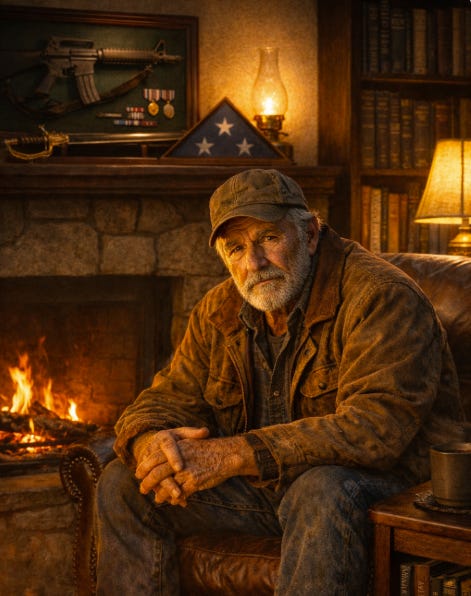
"I sold my mind and gave my dreams away. And tomorrow, I’ll start lookin’ around for yesterday.”
— Dr. Hook and the Medicine Show
There are some things a man says because he believes they will change the world, and others he says because conscience will not permit silence. This is the latter sort.
I’ll be plain with you here; I do not speak to you now from optimism. I would like to. God knows I would prefer to believe that a few well-chosen words, set honestly before decent people, might still be enough to arrest the drift of a society that has gone careless with truth, careless with language, and increasingly careless with the moral boundaries that separate civilization from savagery. But age, observation, and history have a way of sanding down that kind of innocence. I have lived long enough to know that warning people is not the same thing as influencing them.
And yet, I feel compelled to try.
I don’t have any silly illusions that I’m some sort of prophet, and I certainly don’t believe I have discovered some new danger unique to our age. There is very little new under the sun where the failures and habits of man are concerned. Old evils return in modern clothes, speaking fashionable language, draping themselves in the moral vanity of the moment, but they remain old evils all the same. They return because human nature hasn’t changed, and because every generation produces enough people ignorant enough never to know what’s behind them, and arrogant enough to think it has somehow outgrown the permanent things.
What concerns me is not merely that our society has grown more divided, though it plainly has. It is that more and more of our countrymen seem unable to recognize the nature of the path beneath their feet. They think they are improvising, reacting, venting, correcting, resisting, even creating. In truth, they are walking a very old road, one that begins in wounded language and moral confusion and ends, more often than not, in cruelty hiding behind a carefully crafted veil of righteousness.
If you want to understand how a society begins that walk, you first have to understand that it rarely starts with violence.
It starts with words.
Words are the voice of ideas and thought itself, so as words and their definitions are manipulated, so too are thoughts and ideas. Words and their meanings have to come first, so when you see them begin to morph, when you see definitions that no longer define, and when the meaning of a word can just as easily contain its own opposite, you’re witnessing pebbles ahead of a landslide.
Civilizations do not collapse because people suddenly forget that murder is wrong, for example. They collapse because people slowly begin redefining what counts as murder, what counts as innocence, what counts as justice. The words stay the same, but their meaning begins to drift, and before long the moral compass that once guided a people is knocked quietly, inexorably, off its true north.
Take the idea of “the innocent.” Once upon a time, that word carried a very plain meaning. An innocent man was simply one who had not raised his hand in violence against another. He might be foolish, arrogant, wealthy, poor, irritating, eccentric, or completely wrong about the affairs of the world, but so long as he had not initiated harm against his neighbor, he remained under a simple moral protection.
You did not get to hurt him.
That rule was not complicated, and it did not require you to approve of the man’s politics, his religion, his profession, or his opinions. It required only that you recognize the boundary between disagreement and aggression. But notice what begins to happen when a society grows restless with that simplicity. A man is no longer judged by what he has done or by the life he has lived. He begins to be judged by what he represents.
Someone will say that he participates in a system that causes harm. Another will say that he benefits from injustice. A third will insist that his profession, his wealth, or his silence makes him complicit in the suffering of others. And with that small shift, the shield that once protected the innocent begins to thin.
Once a man is judged not for what he has done or for who he is as an individual, but for what he represents, the next step arrives almost automatically. The individual begins to disappear altogether.
“He” quietly becomes “They.”
The man himself no longer matters. His personal choices, his motives, his character, his decency or lack of it - these things fade into the background. What matters now is the category he has been assigned to represent. He is no longer a man with a name and a life, or even just a voter with opinions different from your own. He becomes something larger and far more convenient. He becomes a symbol. An avatar. A living stand-in for an entire class of people who can now be spoken of in sweeping terms that would once have been considered grotesquely unfair. Once that transformation takes place, the moral arithmetic changes in a hurry.
Once the definitional chemistry takes effect and words can mean whatever you choose, you are no longer dealing with a man. You are confronting Them. “They,” you will soon be told, are not merely mistaken. They are not merely pursuing interests different from your own. They are not simply navigating the same complicated world through a different set of priorities. No. “They” are part of something coordinated. Something malignant. Something that must be opposed.
Once that idea takes hold, every disagreement becomes evidence. Every difference becomes confirmation. Every action, every success, every failure, every silence becomes proof that the enemy is real and that the danger they represent is growing.
In this way the imagination does most of the work. The enemy expands in the mind until he is no longer a collection of individual human beings with conflicting motives and complicated lives. The individual disappears still further as “They” becomes a single dark shape. A thing.
And once a people begin speaking of their neighbors as a thing rather than as individuals, the old protections that once restrained cruelty begin to weaken very quickly because the mind finds it much easier to hate a category than a man.
Once that transformation is complete - once a man has been turned into a category, and a category into an enemy - the next step is almost inevitable.
Hatred begins to gather. You need to understand something about hatred if you wish to understand mass movements. Hatred is not merely an emotion. It is one of the most powerful social adhesives known to man. It binds people together quickly, often more quickly than shared ideals ever could.
Love of an idea requires patience. It requires discipline, understanding, sacrifice, and the slow work of building something better.
Hatred requires none of those things. Hatred asks only that you agree on who the enemy is, and that he should suffer. Once that agreement exists, a thousand other disagreements can be ignored. Differences of class, religion, education, temperament, and even ideology can suddenly coexist quite comfortably inside the same movement so long as everyone shares the same object of anger. The enemy becomes the center of gravity.
And as the anger gathers, something else begins to happen. Something more subtle and in my studied opinion, far more dangerous.
The simple act of condemning the enemy begins to feel too good to ignore. At first, it is small things. A cutting remark. A public humiliation. The destruction of a reputation. Each act produces a kind of emotional reward, a brief surge of moral satisfaction that tells the participant he is on the side of righteousness. He’s no longer right because principle shows him to be right. We did away with that guidepost when we redefined what principles are. Now, he’s right because he feels good. Feeling good about a position is all that’s required anymore, so the self-congratulation circle reinforces every bad thing he’s doing.
Soon the reward grows stronger. The misfortune of the enemy becomes cause for celebration. His suffering becomes evidence that justice is advancing. His humiliation becomes a kind of public theater in which the crowd reassures itself of its own virtue. The idea begins to take hold, rarely stated openly but felt everywhere, that the pain of the enemy is proof that the cause itself must be just. “My enemy suffers, therefore I must be right.” It is a remarkably powerful delusion, and one that has fueled more cruelty in human history than perhaps any other.
Once a people begin measuring their virtue by the pain inflicted upon those they despise, the descent of society and especially of culture accelerates quickly. The moral restraints that once governed their behavior loosen, because the emotional rewards for cruelty now outweigh the quiet voice of conscience.
There are always those who resist. Those who cling to principles and a personal ethos that restrain them in the face of wrong choices and bad actions. And yet, even in the midst of that gathering storm, another truth remains quietly present. It’s one ol’ Drill Sergeant Jenkins made damned sure we all knew in our heart of hearts before going off into battle.
The enemy still has a say.
That is the part people most wish to avoid thinking about. It is the stone in the shoe of every comfortable theory about human progress and universal goodwill. We would all prefer a world where reason alone settles disputes, where men of bad intent can be persuaded back to decency with enough patience and the right arrangement of words. But the world has never worked that way.
You can wish for peace with all your heart. You can hold no hatred toward anyone. You can extend tolerance to every belief, every opinion, every strange or different way a man might choose to live his life. None of that prevents another man from deciding that you, your family, your country, or the things you cherish are intolerable to him.
That is the hard truth. A lion will still eat you, no matter how much you love it and admire its beauty. A snake will not pause in its strike because you meant it no harm. The natural world is not governed by your good intentions. Neither, unfortunately, is the human one.
There are moments in the life of every civilization when tolerance ceases to be enough. Moments when destructive force advances purely because no one stands firmly enough in its path to stop it. Because the quiet individualists who would, above all things, rather live and let live cannot or will not get involved. I worry very much that we are approaching a time when that’s no longer going to be an option.
The surgeon does not remove a tumor because he hates the tumor. He removes it because allowing it to remain would destroy the body that sustains life itself. The act is painful. But the alternative is fatal.
So it is with the preservation of a civilization. The only thing that halts destructive force is a protective force committed to preserving what matters. Not vengeance. Not cruelty. Not the intoxication of seeing one’s enemies suffer. Restraint in service of preservation. Protection.
And this is the point where many people begin to feel uncomfortable. Because acknowledging that reality requires something our present age increasingly struggles to do.
It requires the courage to call a true threat what it is. And I don’t metaphorically or rhetorically. I’m not talking here about using the word as a tribal insult thrown at anyone who disagrees with us. But as a sober moral judgment grounded in principle.
And here we arrive at the source of my pessimism and profound concern.
The moment you attempt to speak that truth, you find yourself standing in a strange kind of social fog. The words you use sound familiar. Your adversaries use them too. But you quickly discover that the meanings beneath those words are no longer shared. You say principle and mean something fixed. A guidepost that restrains your actions even when your emotions urge you toward cruelty.
Your adversary says principle and means something entirely different. A flexible instrument that can be reshaped to justify whatever action advances the cause.
You say justice and mean the protection of the innocent. He says justice and means the punishment of those he has declared enemies.
You say evil and mean a behavior that violates moral law. He hears only a political accusation and a hypocrisy to attack.
So when you finally draw the line, when you say, “This must not advance further” the accusation arrives almost immediately.
Hypocrite.
You criticize them for calling their enemies evil, they will say, yet here you are doing the same.
But the accusation itself rests on the very confusion that makes the situation so dangerous. It assumes that both sides are doing the same thing with the same words.
That’s not what’s happening. One side begins with principles that restrain its conduct. The other begins with outcomes it desires and then reshapes principles to justify them.
To the man guided by principle, words have meaning. To the man guided by appetite, words are tools. And when those two men speak to each other, it might appear that a dialogue is taking place. You could easily mistake what’s happening for a conversation. They may sound as though they share a language.
But they are no longer speaking the same one, and no meaningful information is crossing over.
And that brings us to the part of the conversation that matters most.
If what I have said here has any fragment of truth in it - if words themselves have begun to lose their shared meaning, and if meaningful dialogue between these moral frameworks is becoming increasingly impossible to have - then each of us is eventually confronted with a question we cannot avoid.
What do we do?
The answer cannot be hatred. We have already seen where that road leads, and it’s the thing we’re all presumably fighting hardest against. Hatred is the engine of the very forces we have been discussing, and to adopt it ourselves would simply accelerate the destruction we claim to oppose. But neither can the answer be retreat. It can’t be submission. It cannot be passivity in the face of force.
There is a certain temptation among decent people to withdraw from ugliness altogether. To step back from the argument, to mind their own affairs, to live quietly and hope that the fever passes without requiring their involvement. I understand that impulse better than most. The older I get, the more attractive that path can appear. I have a plot of land way off in the woods that nobody knows about that pulls at my heartstrings harder and harder every day, begging me to leave it all behind and disappear.
But history has a way of reminding us that there are moments when stepping aside is no longer a neutral act. There are moments when refusing to stand in the path of destructive force becomes, whether we intend it or not, a kind of permission that we grant, the price of which is our soul.
Civilizations do not preserve themselves automatically. They endure because enough people remain willing to defend the principles upon which they were built. Ethical resistance is not the same thing as aggression. It does not hunger for conflict. It does not measure its virtue by the suffering of its enemies. It acts to preserve, within the boundaries of principle, and only when those boundaries have already been violated by someone else. It never seeks violence, but neither does it tolerate violence when it is directed at the innocent. If a man stands between aggression and the innocent, if he acts within the discipline of principle and not the intoxication of revenge, then the tragedy lies not in his action but in the circumstance that made it necessary. The guilt belongs elsewhere. The rest of us, meanwhile, have our own responsibilities to consider.
There is a time for tolerance, and it should always be our first instinct. A free society depends on the ability of very different people to live beside one another without demanding conformity. But there is also a time to stand. To recognize that some things in this world are worth defending, and that if it must be done, them it might as well be done by me. And if it must be done, then it might as well be done early enough to matter, and with enough resolve to make it final.
For my part, that line was drawn long ago. I swore an oath before God and my Flag to protect and defend my Nation and its Constitution. That oath was not a poetic sentiment, and I suspect most veterans would say the same. It was a promise, made with the understanding that the future might one day demand something difficult in return. As I watch the currents of our time, and as I compare the enthusiasm of those who wish to tear down with the quiet hesitation of those who would preserve and protect, I sometimes find myself wondering how the story will end.
I wonder whether I will finish my days having helped preserve my country, or simply having outlasted it.
I pray every day it is the former, even in the knowledge that prayer without action is simply the pathway to making this my children’s battle to fight, and that prolonging the struggle will only make it that much harder for them to win.